I have to guiltily confess as a child and youth I had little to do with Aboriginal people and, in many ways, scarcely gave the issue a thought. I was too busy living in my own bubble trying to sort my own life out to worry about other people’s lives.
On my very first visit to the Wayside Chapel in 1970 I attended the church service on Sunday night and that was the beginning of my social conscience. The hymn book they used “Travelling to Freedom” contained many stories of the struggle of marginalized people.
At the same time, I was shaken by the number of homeless, abandoned and runaway young people flooding Kings Cross and I felt I had to do something. I vividly remember Ted Noffs in his white suit, white shirt, white shoes and white tie proclaiming “if you are not part of the solution you are part of the problem”.
This was just after Ted and others had led the Freedom Rides throughout NSW. This was a busload of Aboriginal and non-Aboriginal people rolling up into a country town and standing up to the racist laws around swimming pools, pubs and clubs etc. That movement created massive change in Australia and many of the young people who travelled with Ted went on to careers of distinction.
It has always been one of my regrets to not have been one of that group.
It was at this time, Charlie Perkins came into my life. He and Ted Noffs led the Freedom Rides. Charlie and I used to sit and talk. I can vividly remember one day, driving up Bathurst Street in Sydney and seeing Charlie sprawled across the bonnet of a police car while he was being frisked. It was not a pleasant sight and moved me deeply. It was then, first hand, I learned about “Racial Profiling”.
The Wayside Chapel was a centre of activism as well as Kings Cross being a magnet for those in need. The more I worked with homeless people and runaway and abandoned children the more I saw for myself the racism so many Australians blatantly deny exist.
I came across many stolen generation Aboriginal children who would run away from the institutions the failed adoption families had sent them to. I heard first-hand horrifying stories of abuse conducted by the very people who were supposed to have the interests of these children in their hearts. There was a little Aboriginal girl, probably twelve years old, who would repeatedly run away from an institution. She would end up with me and I would do my best to look after her. She would tell me the stories of rape and abuse going on in these homes. When I complained about this, I found I wasn’t taken seriously and any issue I raised was brushed under the carpet. The authorities would not act. It was decades later, this little girl told me how she would rub her Aboriginal skin on the stones of the walls of the institution she was in, in the hope of her skin turning white so she would not be raped any more.
I was lucky enough to meet many of the prominent black activists of the time, particularly, Gary Foley, Billy Craigie and others. I was honoured they would let me speak on platforms with them. More and more people would tell their stories and, in a way, their suffering became part of my DNA. Nobody should have suffered what they suffered and their pain and anger was plain to see.
Perhaps what transformed me most happened because of Cliff, a young Aboriginal stolen generation man I met. Cliff and I became close friends. Cliff was homeless. He could write in the most beautiful copperplate the mission had taught him. He often would come up to my office and we would talk. Sometimes for hours. I have a letter from him which I treasure.
Cliff was a homeless alcoholic and I would frequently get him out of trouble although sometimes I had to call the cops on him because he had done things I couldn’t condone.
On the day my first marriage collapsed I was sitting on the steps of the Wayside Chapel feeling the most dejected and all alone. I saw Cliff come lurching out of the darkness.
“Mate, he said. “I have just heard what happened and it is terrible”. I couldn’t speak and Cliff came and sat down beside me. “I’ve come to sit with you” he said, and if it was necessary, he would still be sitting with me over forty years later.
I have learned over time, that it is often the most neglected, abused and disenfranchised who are the most forgiving. I have seen this over and over again with Aboriginal people and communities where, if what had happened to them had happened to me, I think I could never be that forgiving.
Years later my work extended from Ashfield to the Aboriginal people in Redfern and I spent many years on and around ‘the block’ working with those in need. Some of my happiest moments are sitting around the great big bonfires they would build on the block to keep everyone warm on the cold winter nights.
I had, of course, connected up with the work of Father Ted Kennedy and the Redfern Catholic Church which had gained a high reputation in working with Aboriginal people. First of all, we helped with their meal service and then counselling and street work with many of their guests. My Exodus Foundation began an Aboriginal breakfast program in Redfern which operated from a caravan and ran for years. Also, I had found that the literacy program we ran in Ashfield worked particularly well with Aboriginal children and we established a centre in Redfern which was opened by Kevin Rudd.
Then at Ashfield, a curious thing happened. Shirley, an Aboriginal elder, dropped into our church service.
“I don’t know really why I am here’, she told us all. “The Christian religion is the white man’s religion and I don’t know why I am here”.
A few weeks later, again in the church she told us of her disabled son who needed visiting. One of our elderly white, Australian males, volunteered to regularly keep visiting him. It was moving to watch.
On another Sunday, Shirley told us her story was being told in the Sydney Morning Herald. She took a flower out of our vase to take with her. In the morning, in the paper was Shirley’s photo holding the flower and telling the most terrible story of being stolen from her loving parents.
The next Sunday Shirley turned up for church and we hugged her. She was so overcome with emotion that she let out a moan which rattled the very walls and foundations of our building. After church that day we all went home sadder and wiser as we had all caught just a glimpse, just a tiny glimpse of the pain stolen generation people feel.
Sitting around the camp fires in Redfern I heard so many similar stories. Children being scooped up, dragged into vehicles while their mothers were left screaming on the roadside. Over and over again, I heard these stories and it still amazes me we allowed this to happen.
Within a very short time our literacy programs, designed to keep Aboriginal children at school, was extended to Darwin where it still goes on today. Over the years our program has waxed and waned as funding has allowed. We are currently in two schools there and are looking to expand throughout the Territory. Over this time, I have met countless Aboriginal elders. In fact, it was the Aboriginal elders there who invited us to come into the Territory. “We will do all the cultural stuff”, they told me “just teach our children to read”. I am proud to say we regularly take Aboriginal children from the bottom of the NAPLAN score line to above those kids who attend the toffiest schools in Australia. Many of our kids have won the Chief Minister’s Award for literacy results.
I have worked with countless State and Federal government officials and Aboriginal elders themselves and see their goodness shine through them. Yet, the problems still persist. I regularly hear the stories of suffering and neglect. We have such a long way to go. Naively, forty years ago I would have thought these issues would have been sorted out by now.
When you look into a young child’s heart, you see no colour, just beating love.
People often say to me, “I didn’t abuse Aboriginal people so why should I feel guilty”? That would have been me forty years ago before I myself had seen and experienced for myself the suffering first hand. Many Australian’s won’t understand this but then they haven’t been subjected to these generations of abuse and neglect. To many of us there are things worse than death and one of them is to have your very identity taken away from you.
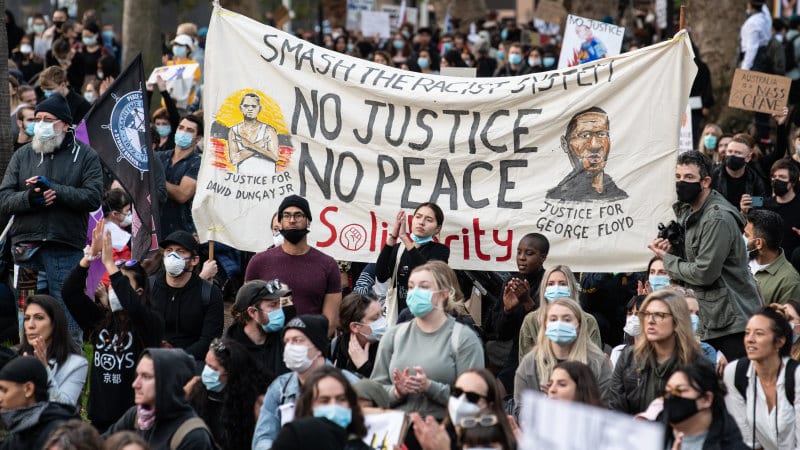
I can well understand, in this time of coronavirus, why so many Aboriginal people and their supporters have marched in cities all over Australia. As one said to me “This is our one big chance to make permanent change. We can’t let it go – it is something I’m prepared to die for”.
Over the years I have become very sensitive to the callous nature of casual racism of Australian society and often the ignorance expressed and the unwillingness to look deeper. One only has to delve into history to see what has been inflicted on our first inhabitants. Someone likened Aboriginal culture and society today to be like a beautiful spider web, glistening and shining in the dew and the sun. Someone has taken a shot gun and fired at the web, so it hangs with bits dangling here and there, flapping in the breeze. So many Australians don’t realise the Australian country side has Aboriginal feet walking all over it and so it’s burned into the soul of every Aboriginal person. Loving the land and yearning for the culture. It is a sadness in which we all lose out.
Years ago, I took a group of disaffected, displaced Australian youths into the countryside to meet with Aboriginal elders. The kids and the elders all sat in the dirt together and the elders shared their stories and love of the land. These Aussie kids were from many different backgrounds and been in heaps of trouble. All of them had disfunctional parents and so were rootless. After this time together the kid’s anxiety level dropped amazingly. They felt a sense of connection to something and a spirituality they had been yearning for. They went home different kids.
That experience is burned in my brain forever. We are all searching in one way or another. The Aboriginal people I know have so much to teach us.
This age of Coronavirus highlights to me how connected all human beings are. I am realizing that thoughtless neglect, abuse and racist regimes can actually now be as damaging to the whole world’s population as well as the minority they abuse. These alientated groups can be petri dishes for future pandemics. We all have to realise we are all now our brother’s keeper. We might worry about Aboriginal people marching at this time, but we have created the conditions where individuals can grab the opportunity and march. It’s kharma really. Nowadays the more we put other people in jeopardy we more we put our own future in jeopardy.
This is my Black Lives Matter march, if I tell you what I have experienced and share some of these experiences perhaps I can turn your mind around so that you realise we are all one, really.


